12.06.2014

Joan: From Armor to High Fashion

As I was thinking about Cindy’s presentation on Joan’s male dress, it actually prompted me to question whether Joan has inspired any modern dress, although I had no doubts her cultural imprint would, of course, encompass the realm of fashion. One of the first items I ran across was a 1998 Alexander McQueen fashion show, in which he utilized Joan as an inspiration. Interestingly enough, in a video in which McQueen is interviewed about the show, McQueen himself states that he was “pushing boundaries.”  Thus, in this way, McQueen chose the right inspiration, as Joan did push the boundaries of societal restrictions. McQueen goes on to comment “you can’t get much stronger than a head of an army.” Therefore, the “strong” Joan was clearly the one at large in this particular fashion show. As to the actual clothing, some of it is strikingly red, other includes bits of material that at least appear as chainmail, and some of the models even take on a bald appearance. Finally, the spectacle ends dramatically with one model in the middle of a ring of fire as you can see below, to indicate Joan’s burning. What do you think of McQueen’s inspirations from Joan?

To watch the interview and clips of fashion show: https://www.youtube.com/watch?v=yN1gS2KcK0w
Some of best images are in the above video, but here are a few as well:


12.04.2014

Joan as Leader of Men

In is article “A Woman as Leader of Men: Joan of Arc’s Military Career” Kelly DeVries provides an argument on why the soldiers in Joan’s army chose to be loyal to a young peasant woman.  It would seem to be counterintuitive for the French soldiers to be okay with having a woman as their captain. However, Joan ended up being one of the most influential captains in the Hundred Year’s War. Her soldiers followed her into battle and seemed to have no ill feelings about this, as they all remembered her and her military capabilities fondly years later at the Rehabilitation Trial. DeVries points out that women leaders were rare in the Middle Ages and could even have been used against Joan. He states that “Often, too, the rumor of a woman leading an opposing army had been used by eaters to incite their troops against the obvious heresy, sorcery and immorality of their opponents” (DeVries 4). This is exactly what the English did in response to Joan. One soldier at Orleans asked whether they were expected to surrender to a woman and called her soldiers “unbelieving pimps” (DeVries 4). 

DeVries goes on to argue that Joan shares many similarities with a mercenary captain, who would command large numbers of soldiers who were very loyal and who in return received various forms of payment. In explaining this idea, DeVries says that “Joan did not offer her troops terrestrial possessions; she offered them religious possessions, in particular salvation” (DeVries 5). Joan’s religious presence was very important to her military success. Her faith and the holiness that she represented seemed to make her soldiers that much more loyal to her. DeVries states that Joan’s soldiers “seemed to have welcomed the holiness that she represented, and in fact some marveled and even relished the spirituality of their own existence when with her” (DeVries 12). 
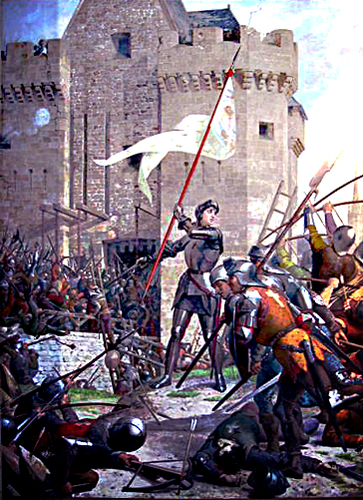
Joan leading the attack on the Tourelles. 
                           By Jules Levenpeu
My research paper is about Joan and other Medieval female warriors. Part of my paper will focus on how Joan was atypical in the fact that she was not only accepted and liked by her fellow soldiers but that she was also respected and followed. DeVries’ analysis of why Joan’s military career was so successful directly relates to my argument. In comparison to other female warriors at the time, Joan did not already command respect because of her family, but she garnered more respect on the battlefield anyway due to her natural talents in warfare, but also because of her religious position. It is easy to prescribe her military success to her military capabilities, but, as DeVries points out, her religious standing is just as important.


 DeVries, Kelly. “A Woman as Leader of Men: Joan of Arc’s Military Career”. In Fresh Verdicts on Joan of Arc edited by Bonnie Wheeler and Charles T. Wood, 3-18. New York: Garland Publishing, 1996. 

An Open Letter to Joan of Arc

As I think back over the semester, I cannot help but feel immense gratitude for Joan. I am grateful first for the strength and courage she exemplified. She was unafraid to forge a new path for herself – and one no less that her parents nor society were quite fond of. I am also thankful for her steadfastness in both religion and moral conviction. She was indeed unwilling to compromise what she wanted for her life, a lesson any twenty-something can surely relate to. Lastly, I am thankful for Joan’s sensitivity. She was brave and strong, but she also displayed gentleness and kindness. I am thankful for her example, and revealing over five hundred years prior that women can do and be both. After feeling oddly nostalgic for both Joan and the experience of this class, I have taken the liberty of comprising an open letter to Joan from those who desire to study her.

Dear Joan,

Your life and experiences rings out from the history books. You are often discussed and debated, but scholars and students alike are seldom able to definitively describe your existence. You defied numerous societal norms and rules of your time, unwavering in your beliefs. You bested the English in combat, although you lacked any knightly training or otherwise. You gained male friendships, while remaining a virginal anomaly. You often outwitted the judges at your trial, never forgetting to speak strongly. And lastly, you went to the stake, dying for your cause.

Because of these reasons and so much more, we study you. The historical records often provide answers, and yet we debate. Primary sources reveal the extensive following you had, a following that has outlived even you. You are questioned, revered, misunderstood, and cherished. Regardless of what answers scholars will provide next, we thank you for your humble and yet astonishing life. May we seek to better understand you.

Sincerely,


Those Who Simply Wish to Know You More

"Jeanne at the Coronation of Charles VII in the Cathedral of Reims" by Jean Auguste Dominique Ingres, 1854. 

12.01.2014

"Pearl" -- Katy Perry

Katy Perry has many empowering songs along with fun songs. One song that I stumbled upon included Joan of Arc and also fits the feminist theme. Her song "Pearl" is about a girl who is forced to dim her potential by a guy because of the strength of their love.

The song compares the girl to the statue of Liberty, a pyramid, hurricane and other strong and powerful influences, including Joan of Arc. It suggests that Joan of Arc is a strong and admirable woman that girls should look up to. With the inclusion of Joan of Arc, Perry also has a recurring line "She is unstoppable".

Joan of Arc is used as an image for oppressed women to stand up for themselves and to use their full potential, regardless of an obstacles. In the end of it all, those who try to diminish who you really are and what you can do have no power to take it from you, just like Joan. Although the court tried their best to make her terminate her belief and style, and were successful for a short time, Joan returned to who she was knowing it would cause her death.

This song is very similar in its use of Joan as Gage's play. It takes her life to illustrate larger issues in the society, in this case domestic violence or women's rights.


Lyric Video:
 https://www.youtube.com/watch?v=dKMDXnPmWDM

Photo:
http://www.pearlsonly.com/blog/wp-content/uploads/2014/04/Katy-Perry-Photoshoot-Wallpaper2.jpg

11.28.2014

Blashphemous Joan


Doing research for my paper I came across an image of Joan in our, Joan of Arc: Her Image in France and America.  It is captioned, “’Joan as Minerva,’ frontispiece from Friedrich Schiller, Joan of Arc, or the Maid of Orleans” (Heimann and Cole 42).  Like the caption states it is Joan of Arc as Minerva the Roman goddess of wisdom, her Greek equivalent of Athena. 

I imagine, Joan would have been appalled by this image of her as a pagan goddess.  The thought of a Christian soldier being honored as a Roman goddess is quite idiotic no matter your religious affiliation.  Although Schiller was a successful writer, I cannot see how any successful writer would allow for the main character to be displayed as something that the character would have not approved of.  A writer’s purpose is to capture the moment, the mood, the authenticity of the moment, not distort it.

Schiller’s Joan does make sense from a purely analytical point of view; as Minerva was the Roman goddess of wisdom.  Joan of Arc was excellent at maneuvering troops and lifting sieges, the characteristics of a wise person.  And her wisdom did not come from any real schooling other than what her mother had taught her and from God’s words as well as her voices guidance. 

 
Was it appropriate for Schiller to allow Joan to be portrayed as something Joan would have probably disliked?


Works Cited:

Heimann, Nora and Coyle, Laura.  Joan of Arc: Her Image in France and America.  London, UK: D Giles Ltd, 2006.

11.24.2014

The Different Viewpoints: Response to Barstow Article

     In the excerpt in the course packet written by Anne Llewellyn Barstow, she provides many examples throughout history of how Joan was an example or influenced them. It amazed me was the extremes that Joan has influenced. I understand how Joan influenced many of the feminist movements. Joan exceeded and went beyond was expected of her in the life time like the women in these movements are aspiring to. It did not surprise me. What did surprise me was some of the ends that Joan did inspire.
     One example was Isabel O'Reilly, who wrote a Roman Catholic treatise. What was interesting about this part was she had the main point of that a woman's place was in the home. She uses Joan as an example and admired many aspects of her life like her virginity and how she was able to spin. She claims that Joan can be the model for the traditional Catholic woman, despite the fact that Joan left the home. The reason Joan still qualifies was because she was commanded so by God. From my point of view, it is a long shot to claim Joan a model for Catholic women. Times change and there is a a significant time difference between Joan's lifetime and 1894 when O'Reilly wrote this. I do believe she is a great example, but naming a single model for Catholic women is impossible.
     On the other side of the extreme was the mention of the Ku Klux Klan. The women's order of the KKK wrote Joan, the Militant Kamelia. This claims that women in present day (then 1920) hear voices telling them to establish the supremacy of the white race. The claim was those voices were similar to the ones Joan heard to motivate her to liberate England from France. This surprised me because such an extremist organization associated themselves with a Saint like Joan. It seemed as if they used Joan to justify their actions and beliefs. I personally look at their actions and disagree with their train of thought in this one.
     My biggest take away was how Joan inspired many different groups. What surprised me the most was the certain groups that associated themselves with Joan and what they took away from Joan. Some of the examples made sense, but others raised a few questions for me. I enjoyed the reading in the sense that it provided an insight to me of how others reacted to Joan.


11.23.2014

Who is Joan to women?

Anne Barstow's "She Gets Inside Your Head: Joan of Arc and Contemporary Women's Spirituality" uncovered many interesting truths about how women portray Joan of Arc as a trend-setter for women. In Anne's chapter, she asks contemporary women what Joan means to them. She shows how women have adopted Joan for women's rights movements, spiritual role models, redefining their place in the home, and showing courage.

Barstow begins by calling on the events of the Seneca Falls convention of 1848. At the convention Elizabeth Cady Stanton used Joan's mysticism to further her reformist faith. She is quoted by Barstow by saying "when all human power seemed unavailing, the French no longer despised the supernatural aid of the damsel of Domremy." She also applies Joan's strategies to reform-minded women by saying that women hear voices every day. She says these voices come from sorrow, degradation and despair. By applying Joan's actions to her own cause, she puts Joan down on their level. Her mind set was if Joan could do it so can we.


Conservative women also had their chance to apply Joan's image to their cause as well. According to conservative women, Joan was the model of the woman in the household. Barstow points out that this view is contradictory to Joan's life. Isabel O'Reilly praised Joan and explained that Joan was an exception to her dictum of a woman's place in the home. This was because Joan was commanded by God to enter public life. Barstow concluded that Joan was not a martyr in the eyes of women but a powerful visionary.


Barstow also discovers what Joan's voices mean to women as well. The survey revealed that few women mention her voices. When they did, they described the voices as a single voice from God and that Joan obeyed God despite the doubts and pressures from the outside world. This prompts some women to follow their own "inner voice" and to follow what they really believe.


I thought it was interesting that Barstow also included information about other women hearing voices just like Joan. One woman, a former Mormon explained that "Voices tell me what to write, give me no peace until I've done it and then more speak up." It is interesting that women that do hear voices of some kind try to make this connection to what they're experiencing to what Joan experienced. Other women explained that Joan showed how to be true to ones beliefs and provides an example of saying no to peer pressure.


Barstow's survey also uncovered some extreme beliefs about Joan of Arc and what their thoughts about her were. One woman rejected Joan's image and described it as "simpering, syrupy piety" and that she had an obligation towards martyrdom. Others thought that Joan's story made the Church look scary. Another even prayed to Joan at an altar and even meditating on a statue of Joan.

These cases reveal that Joan is wide open to interpretation. Women see Joan as a role model both spiritually and morally. Although interpretations vary greatly on what she was, she has proven to be a go-to source for women who need direction and are looking for answers. Barstow's survey also revealed that people choose what they want to see in Joan. Women look at Joan and focus on what they need help with. Although Joan has been looked at in every way possible, she continues to be a source for women to look up to and look for answers.

Work Cited

Barstow, Anne. "She Gets Inside Your Head: Joan Of Arc And Contemporary Women's Spirituality." In Coursepacket compiled by Dr. Woldbrink. Fall 2014.