As we read earlier this week, Joan was captured at the town of Compiegne by the English and the Burgundians. Her capture came after she was trapped outside the gates of Compiegne. This happened because had Burgundian and English troops behind her as she ran to the city gates. Guillaume de Flavy raised bridge to the town and had the gates closed to the city in fear of losing the whole town to the English and the Burgundians. This trapped Joan and a few of her men outside the gates and allowed her capture.
After reading this I can say that I probably would have made the same decision to raise the bridge and close the gates in the face of hundreds or thousands of men running at the town. I have been thinking however, would Guillaume de Flavy have made the same decision to raise the gates if he could actually see Joan retreating back to the town? What could he have done differently to change the outcome of history?
Gorges Chastellain's account of Joan's capture tells us that she was on her horse when she was retreating back to the town. The sources don't tell us how far behind the Burgundian/ English forces were behind Joan when she was fleeing. If Joan had a far enough lead, maybe the bridge could have been raised after she crossed it, thus escaping capture. This brings into question how long it would have taken to raise the bridge to the town. If Guillaume de Flavy knew the English/ Burgundians could have gotten across the bridge before it could be raised, he may not have had a choice.
It is also hotly debated whether or not de Flavy betrayed Joan trapping her outside the gates. Some such as author Kelley DeVries, believes that Joan may have been betrayed by de Flavy when he raised the gates. I have thought about this same question a lot. What do you all think? Did Guillaume de Flavy betray Joan or was Joan's capture inevitable? Could the outcome have been any different than what we know happened?
Work Cited:
Pernoud, Re. Joan of Arc, by Herself and Her Witness. London: Macdonald, 1964. 150-151.
DeVries, Kelly. "Joan of Arc." Google Books. January 1, 1999. Accessed October 27, 2014.
10.26.2014
10.23.2014
De quadam puella
De quadam puella (Summer 1429?)
In our Taylor book, there was a source called De quadam puella, written sometime in
1429 and the author remains a mystery because modern scholars are not fully convinced
that it was written by Jean Gerson. In this treatise, it presents positive and
negative views of Joan, certainly whether or not she truly was a virgin pucella
sent by God.
A couple questions are asked by the author in the source,”
should one believe that she is truly a young girl, human and natural, or was
she changed into a similar, fantastical likeness of a person”? (Taylor 113).
Second, the author asked,” If it is through a superior
cause, is this for good, and therefore by a good spirit, or for bad, through an
evil spirit”? (113).
Examining these questions, he presents propositions in
support of her and later on, near the end of the treatise he ultimately opposes
her.
He starts by presenting proposition of supporting her, he states,” It must be simply
affirmed that this is a true Pucelle and a genuine person of human nature”(113).
It is convinced that she is a human because of her human actions. And according
to Taylor,” The young female is continually found to conform with other men in
human actions, speaking, desiring food, eating, drinking, staying awake,
sleeping, and other similar things”(113). Based on her “human activities” we know
Joan was indeed a person of human nature and not immortal or essentially evil.
In the author’s IV proposition he states,” It is consonant
with the holy scriptures that God may present the joy of salvation to people
and to kingdoms by means of the weaker sex and innocent youths”(114). Based on
our previous sources, we’ve learn there are other women before her who were also
messengers and sent by God other than men.
The treatise also presents the negative positions about
Joan. In proposition number 1, he states,” Many false prophets have come,
claiming to have been sent from God by divine inspiration”(115). And according
to Taylor,” in the law of the gospel, many will say that they come in my name
and many will be deceived by them”(116). This is saying that there have been
many before Joan who has claimed false prophets; therefore that questions Joan’s
creditability. In the V proposition that
opposes her, states,” This Pucelle commits two actions which are defined as forbidden
in the holy scriptures” (117). Taylor defines these actions based on her cross
dressing and cutting her hair as a man (117).
I found this source really interesting because although the (mysterious)
author presents a fair amount of positive and negative points about Joan, I am
not fully convinced that the author was supporting Joan. It ultimately opposes her. This is not surprising because of the time period and the situation that
Joan was in. If the author had written the treatise twenty years later, perhaps
it would support Joan more.
What do you guys think?
Source:
Craig,Taylor. Joan of Arc: la Pucelle. Manchester University Press, 2006. Print.
More Frozen: Anna vs. Joan
Since I've already made one Frozen post, I'd thought
I'd stick to a theme. ABC's series Once Upon a Time has co-opted the Frozen
storyline in order to cash in on the hype surrounding the Disney movie,
which has resulted in some more Joan of Arc references. This new version picks
up where the Disney movie leaves off. Elsa is Queen and Anna is about to marry
Kristoff, but then Elsa reads her mother's journal and believes that their
parents left because of her. Anna doesn't think this is true and journeys to
the Enchanted Forest (where the rest of Once Upon a Time's fairytale
characters live) in order to prove her wrong. However, Anna doesn't want just
anyone to find out that she is a princess from another Kingdom, so she decides
to take the name of her favorite painting, Joan.
In my last Frozen post I compared Elsa to Joan, which
I think makes more sense than Anna being Joan. Anna isn't segregated from
society in any way, and she isn't shamed for supernatural abilities. Anna's
naivete borders on dangerous at times, while the nature and results of Joan's
mission, as well as the battles she had to fight along the way, made her more
skeptical and less trusting.
However, one thing that Anna and Joan do have in common is
their penchant to never give up. When a young Prince Charming is confronted
with an impossible obstacle to overcome, Anna is the one who convinces him to
not give up. She teaches him how to fight for his freedom despite the odds
against him (also can we acknowledge that Joan of Arc taught Prince Charming
how to sword-fight?). Joan was also presented with an impossible situation, but
she had faith in her voices and her purpose, and was able to accomplish the
impossible. She even refused to give up in small moments such as the during the
siege of Orleans. The rest of the army was retreating, but she stayed behind
with only a handful of men because she had faith that they would take the town that night. Jean d'Aulon reported that Joan said that "she was not alone, that she still had fifty thousand men in her company, and that she would not leave that spot until she had taken the town" (Pernoud 173). At this moment, Joan did not have any advantages over her enemies, and she only had a handful of men. However, her faith in her own ability to accomplish
the impossible led her to overcome the obstacles placed in front of her.
Sources: Pernoud, Regine. The Retrial of Joan of Arc: the Evidence for Her Vindication. San Fransisco: Ignatius Press, 2007.
10.22.2014
Escape Attempt: A True Leap of Faith?
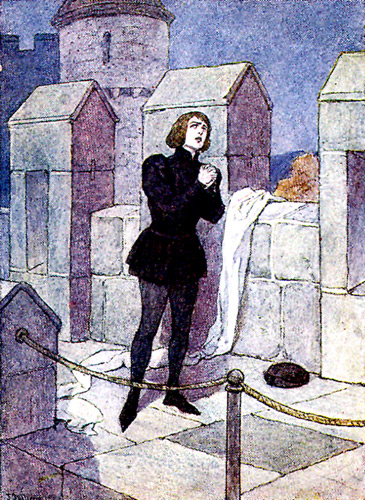
Currently we have been discussing Joan's capture and reading about her various attempts to escape from her imprisonment. One of these attempts involved Joan leaping from the tower of Beaurevoir. While she claims it was not a suicide attempt and strictly a leap of faith, I have to wonder whether Joan really did want to take her own life.
According to Joan, "When I heard that the English were coming to take me, I was very wroth at it, and however my voice forbade me often to leap from that tower. And at last, for fear of the English, I leapt and commended myself to God and the Virgin Mary and I was injured in that leap." (By Herself, 154). To break this quote apart lets start with the fact that Joan's voices did not tell her to leap from the tower. In actuality they forbade her from jumping. Joan went against the will of her voices and jumped. Do we have other accounts where Joan went against the commands of her voices?
Secondly, Joan tells of being fearful of the English. Was she so fearful that she attempted to take her own life versus falling into their hands?
Thirdly, within the above mentioned quote we are told that Joan commended herself to God and was injured in that leap. I have to wonder if this would have put any doubt into Joan's mind about God's plan for her? Meaning, was the injury caused by God not wanting Joan to escape or was it simply because she put too much faith in the fact that God would allow her to escape and made a careless decision?
Was her leap a suicide attempt? According to Joan, "In leaping I commended myself to God, and I thought in making that leap to escape so that I should not be delivered over to the English" (By Herself, 155). Joan believed that her leap of faith would result in God protecting her from injury and allowing her to escape from her imprisonment. However, after the leap resulted in her being injured and being imprisoned by the same people once again, Joan still maintained her faith in God. I have to wonder whether anyone else who sought God's protection in an escape attempt and failed would still have that same level of devoutness to God? Do you think Joan just came to the realization that God meant for her to be captured and sold over to the English? Or do you think Joan ever doubted, even for a second, whether God was still at her side?
Works Cited
Pernoud, Regine. Joan of Arc: By Herself and Her Witnesses. Lanham: Scarborough House, 1994.
Image from http://www.maidofheaven.com/maid_assets/extras/joan_beaurevoir_castle.jpg.
According to Joan, "When I heard that the English were coming to take me, I was very wroth at it, and however my voice forbade me often to leap from that tower. And at last, for fear of the English, I leapt and commended myself to God and the Virgin Mary and I was injured in that leap." (By Herself, 154). To break this quote apart lets start with the fact that Joan's voices did not tell her to leap from the tower. In actuality they forbade her from jumping. Joan went against the will of her voices and jumped. Do we have other accounts where Joan went against the commands of her voices?
Secondly, Joan tells of being fearful of the English. Was she so fearful that she attempted to take her own life versus falling into their hands?
Thirdly, within the above mentioned quote we are told that Joan commended herself to God and was injured in that leap. I have to wonder if this would have put any doubt into Joan's mind about God's plan for her? Meaning, was the injury caused by God not wanting Joan to escape or was it simply because she put too much faith in the fact that God would allow her to escape and made a careless decision?
Was her leap a suicide attempt? According to Joan, "In leaping I commended myself to God, and I thought in making that leap to escape so that I should not be delivered over to the English" (By Herself, 155). Joan believed that her leap of faith would result in God protecting her from injury and allowing her to escape from her imprisonment. However, after the leap resulted in her being injured and being imprisoned by the same people once again, Joan still maintained her faith in God. I have to wonder whether anyone else who sought God's protection in an escape attempt and failed would still have that same level of devoutness to God? Do you think Joan just came to the realization that God meant for her to be captured and sold over to the English? Or do you think Joan ever doubted, even for a second, whether God was still at her side?
Works Cited
Pernoud, Regine. Joan of Arc: By Herself and Her Witnesses. Lanham: Scarborough House, 1994.
Image from http://www.maidofheaven.com/maid_assets/extras/joan_beaurevoir_castle.jpg.
Orange is the New Orleans
On May 23, 1430, one of the most fateful moments in the
young girl’s life, Joan was captured by the Burgundians while attempting to
defend Compiegne from an Anglo-Burgundian siege. Following her capture, Joan
went on to endure imprisonment in numerous castles until she was finally sold
to the King of England and housed in the castle of Bouvreuil to await her
trial in Rouen. There is much modern speculation about Joan’s experiences while
imprisoned, even the theory of a suspected rape. While Joan does not specifically discuss her time spent imprisoned during her trial, several witnesses were able to visit the Maid in her cell, and described the conditions in which she was held.
Some of the most telling evidence of Joan's imprisonment comes from the Retrial records where witnesses from the Rouen trial re-testified about the conditions of the prison as well as Joan's hardships. Pierre Daron, Lieutenant to the bailiff of Rouen, testified: "We found her in a tower of the castle, with fetters on her legs, which were attached to a great wooden block," (Pernoud 209). As to how Joan was guarded, Jean Massieu testified: "Joan was kept a prisoner and remained in that place under the guard of five Englishmen, of whom three stayed in her room at night and two remained outside the door," (Pernoud 210). This constant guarding by Englishmen allowed for the rumors of a suspected rape upon the Maid. Guillaume Manchon testified: "Once or twice [Joan] complained… Master Nicolas Loiseleur that one of her guards had tried to rape her," (Pernoud 211). Whether this attempted rape was successful is much debated among historians today. Perhaps one of the most interesting theories of Joan's imprisonment is the testimony given by several men that claimed an iron cage was made for Joan, in which she would have been forced to stand in her cell, chained. Jean Massieu described having heard from a local blacksmith who crafted the cage, and Pierre Cusquel corroborated the creation of a cage for Joan, although neither man admits to having seen Joan actually enchained.
Perhaps one of the most essential question for understanding Joan's imprisonment is: how did Joan's experience differ from that of an average medieval prisoner? Prisoners in the Middle Ages were rarely afforded certain privileges modern inmates are allowed, including meals, medical aid, and frequent visitors. Medieval prisoners were less guarded or supervised which left them more free but also more susceptible. Joan, however, was under nearly constant supervision by the recorded five Englishmen. The lack of hygiene and small quarters or cells prisoners inhabited during the Middle Ages created an unhealthy environment, as inmates often died of disease. Several Rehabilitation records reflect that Joan fell ill while in prison, and had to be bled. This would seem a fairly typical occurrence in a medieval prison. Although more care was surely administered to Joan, who was essential to the English to remain alive until sentenced. Lastly, the circumstances of Joan being imprisoned with male guards was wholly inconsistent with the custom of the Middle Ages. According to medieval custom, women inmates were held in ecclesiastical prison, guarded solely by women. This, however, was not a liberty Joan was afforded, and created a source of anger that Joan exhibited during her trial.
While historians know much about typical medieval prisons, Joan’s
experience while imprisoned was wholly unique considering the war and double
monarchy of the day. Furthermore, Joan was not a typical prisoner. The rumors of Joan combined with the English dedication to prove her a heretic proves her time spent in prison was unlike that of a common criminal. However, the extraordinary circumstances surrounding her imprisonment align with the extraordinary life she lived before her capture.
Below are several images of the castle of Bouvreuil, where
Joan was imprisoned while awaiting her trial in Rouen. She was held specifically in the tower below.
Works Cited:
Geltner, Guy. "Medieval Prisons:
Between Myth and Reality, Hell and Purgatory." History Compass 4
(2006). Web. 22 Oct. 2014.
Pernoud, Regine. The Retrial of Joan of Arc: The Evidence for Her Vindication. San Francisco: Ignatius Press, 2007. Print.
10.21.2014
Halloween: Joan of Arc
![]() |
| Jamie immediately after giving birth and preparing to run from Uncle Michael |
| Paul Rudd, before he became a comedic actor saving Jamie's baby and the family in the Myers home. |
The voice by the end of the film proved to be a doctor manipulating a poor child who had grown up knowing the history of the house he lived in. Since the film did start with a direct reference to Joan, the director may have ended it with his opinion of Joan's voices. The voice in this film was manipulated by a doctor that knew how to make a 6-year old boy believe he heard an evil voice. Joan could have had voices but it could also have been a manipulation for her to fight in battle and make herself the woman prophesied about. Of course Joan accomplished great feats regardless if it was truly voices telling her what to do or her own doing.
Chappelle, Joe. Halloween 6: The Curse of Michael Myers. DVD. , 1995.
Picture Sources:
https://blogger.googleusercontent.com/img/b/R29vZ2xl/AVvXsEjgd4Pyk0vBIVYqcoMbkTzKwm4lgF_IPxZsvpE7xr14R1k6b_xMGzYyC3T-xp2OtOw1njC9mr1Jj_9UccFo3Vp3wD9PRm7Ls1UpwVJ2fmSCGIZabYESz4OK6RndMDZHvDlhuR4IztQ_Z9Y/s320/Halloween+6+Jamie+and+nurse.jpg
http://www.halloweenforevermore.com/wp-content/uploads/2014/09/Paul-Rudd-appears-in-this-entry.-375x239.png
10.19.2014
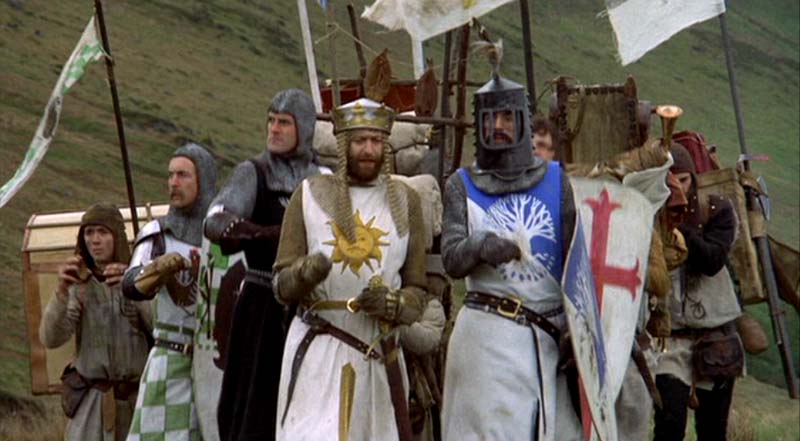
Monty Python and the Holy Grail--Funny but Accurate
There
aren’t many historically accurate movies out there that can make you laugh. Monty
Python and the Holy Grail is one of the few that will. This movie is full of
slapstick humor and is a cult-humor classic. The movie is about the king Arthur
and the Knights of the Round Table and their quest to find the Holy Grail. The
whole movie is accurate in terms of weapons, armor, castles, ceremonies, and
legendary heroes. What this movie does is take these historical truths and poke
fun at them.
The
movie is set in England in the year 932 A.D. From the start of the movie we run
into our first issue with reality. King Arthur appears through the fog
riding…nothing. He skips along on foot acting like he is riding a horse while
his lackey (Patsy) jogs behind hitting coconut shells together to make the
sound of horse hoofs (this is why Dr. Wolbrink had the coconuts in class). If
anyone was traveling over long distances in those days, they would be on a
horse (the no horse trend continues throughout the movie). In the movie, Patsy
is holding a large trunk on his back along with a horn and other camping gear.
One
thing that was historically accurate in the movie were the castles. The castles
were in fact filmed from a single real castle. The castle used was Doune
Castle located in central Scottland and Castle Stalker. These castles have very
high, thick walls with plenty of defenses. In one scene, King Arthur and the
Knights of the Round Table attack a French controlled castle. The attack was
repulsed by the French throwing live animals and other objects over the walls
at the Knights of the Round Table. Although none of the castles had a
human-built moat to hinder troops from taking the castle, the Castle Stalker
was small but built on a small island with a natural lake surrounding it. This
would be a very good defense against attackers trying to take the castle.
Another
thing that was funny but still held some accuracy was the burning of a witch.
In the movie the “witch” is actually a woman that the towns people dressed up
to look like a witch. She has a carrot nose held on with string and a metal
funnel for a hat. The towns people even admit to dressing her up that way but
they test her anyway. The way they test her is they compare her weight to a
duck on a large scale. The logic is witches burn because they’re made of wood,
wood floats in water, ducks float in water, if she weighs the same as a duck
she is made of wood, therefore she is a witch. She does not pass the test and
she is taken away to be burned. This kind of logic was present back in medieval
times when the understanding of how biology worked was not understood yet. If a
bug crawled out from under a rock, the logic was that rock made a bug somehow.
Another
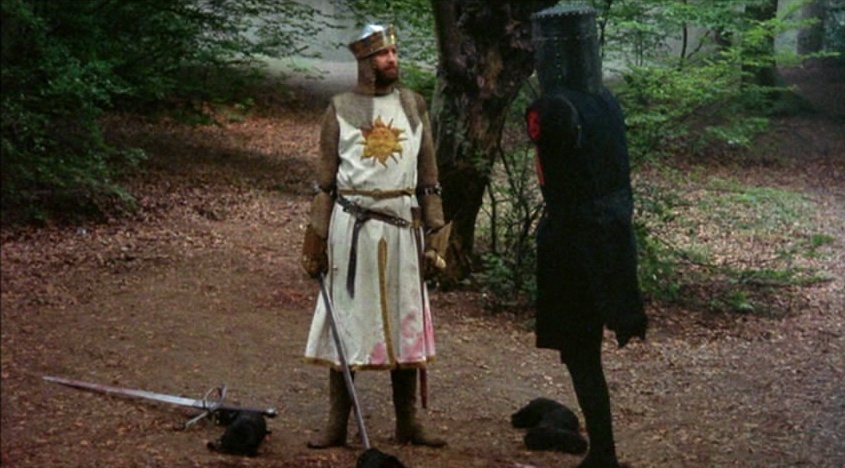
legend that was sacrificed on the altar of comedy was the legend of The Black
Knight. In the movie The Black Knight is seen battling another knight
trying to cross a very small wooden bridge over a small creek (the creek could
be jumped across). His camp is seen on the other side. As the Black Knight
battles the challenger, the fighting style is very slapstick-like. There is no
real honor to style to it and The Black Knight kills the challenger by throwing
his broadsword through the air and stabbing the challenger through the head,
through the opening in his visor. This is not very likely to happen since the
opening is very small but it was very funny.
When
King Arthur attempts to cross the bridge he must defeat the Black Knight, and
he does, with ease. The movie makes The Black Knight look like a weakling and
has no skill in combat. In the movie an interesting point is made when The
Black Knight says “The Black Knight always triumphs!” This I feel was
intentional because in the legends The Black Knight is always the victor.
Instead of sticking to the legend, the movie has its own spin on it. The Black
Knight ends up loosing all his limbs but never bleeds out and says he will bite
Arthur’s legs off (yes this is the kind of movie this is).
Towards
the middle of the movie, there is a scene involving Sir Lancelot and a medieval
wedding ceremony. The ceremony is also accurate. It has a musical group playing
instrauments such as the shawm, the racket (guitar like), a hand drum, and the
reed pipe. In the court yard was prepared food including fruits, vegetables,
and various meats. The marriage ceremony was held in the main hall of the
castle. Friends and family of the bride were present at the party socializing
and dancing. In the scene Sir Lancelot goes crazy and trashes the party by
killing several wedding guests in order to rescue the “princess” in the tower
from her father. It turns out that the prince was the one who sent the note
asking for help, which nullifies the nobility of the quest.
Another
historically accurate object in the movie is the central main character, King
Arthur. The real king Arthur is a larger than life character who wields
Excalibur and is the defeater of the Saxons. The King Arthur in the film looks
accurate for the time period and instead of a lion on his tunic he wears a sun
with a mustache. This is also seen on his standard held by his lackey, Patsy.
King Arthur in the film even alludes to his father Uther Pendragon. The film
has made King Arthur has he should be but they put their own funny twist on his
character.
Although
this film contains mystical or magical elements to it, the film is largely
historically accurate. Nothing in the film that includes dress, weapons,
environment, logic, or technology is inaccurate for that time period. The movie
is a blend of modern touches, mythical legend, and historical accuracy. This
movie is by far one of my favorites and makes me laugh every time I watch it. I
can also just about quote the whole thing. This is a great film to watch and I
would recommend everyone watch it.
Work Cited
Monty Python and the Holy Grail. Performed by Graham Chapman, John Cleese, Eric
Idle, Terry
Gilliam, Terry Jones, Michael Palin,. England: EMI Films, 1975. Film.
Subscribe to:
Posts (Atom)