9.21.2014

Joan inspired by another Joan?

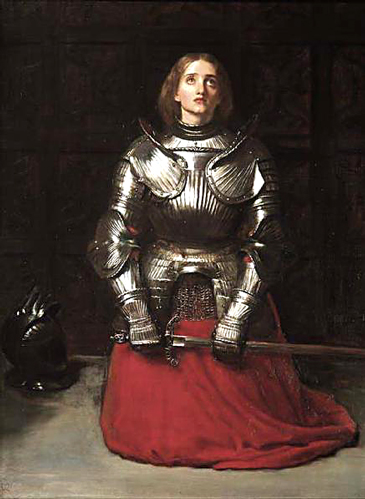
We all know Joan of Arc as this young girl who became famous (or infamous depending on what side you look from) for being different, one of a kind, and radical. After doing a little bit of digging around on the internet, I ran into an article that listed some famous female warriors throughout history. The one that caught my eye was a paragraph on another famous woman name Joan. She too was a warrior who led troops to victory during the Breton War of Succession. Did Joan take inspiration from others before her or was she acting out of pure obedience to God?

We know from reading our text books that Joan was called upon by Saint Michael, Saint Catherine, and Saint Margaret. These were the source of her voices she was hearing which stirred her to take action and do the will of God. Wether Joan of Arc was inspired by another mortal female commander in history is the question. I personally believe that Joan of Arc was not inspired by female commanders of the past. Simply because her mission was her mission. Joan had tunnel vision and could see the task that God commanded her to do and she would do it at all costs.

The other woman that the article briefly paired with Joan was named Jeanne Le Flamme "Fiery Joan."  The story of Both Joans are somewhat similar. The story of "Fiery Joan" entails a married woman named Joanna of Flanders. Joanna was married to a wealthy nobleman named John de Montford, Duke of Brittany. In 1341 John de Montford was arrested and taken prisoner by Charles de Blois in a competition for the dukehood. This didnt set well with Joan so she raised her own army and attacked Charles de Blois to gain control of Brittany. This conflict became known as the Breton War of Succession. After a few battles her army captured Charles de Blois and her revenge was exacted, even though her husband died in captivity. After that she reportedly went insane and was confined to Tickhill Castle where she died in about 1374. Nice right?

After looking at both Joans there are some similarities that arise but there are differences. I know there are a lot of questions to be asked in comparing the two, so what do you think about this comparison?

Work Cited

Mallet, N.H. "Women Warriors -- Meet Seven of History's Most Amazing Female Commanders." Military History Now. 15 May 2013. Web. 21 Sept. 2014. <http://militaryhistorynow.com/2013/05/15/women-warriors-meet-seven-of-historys-most-amazing-female-commanders/>.

Taylor, Craig. Joan of Arc: La Pucelle. Manchester: Manchester UP, 2006. Print.


9.19.2014

Joan vs. Elsa: a Comparison with Disney's Frozen

In keeping with a theme from the last several days, I'll go ahead and make a post about Joan in popular culture, specifically Disney's Frozen. There's one small moment in the movie that I did not catch until very recently (despite the embarrassing number of times I've watched it). It's during the "Do You Want to Build a Snowman?" song, and Anna is lamenting that she has become so lonely that she has started talking to the pictures on the wall. She points up at a painting of a woman with a sword on a horse and remarks, "Hang in there, Joan!"


As small as this moment is, it's one of the few examples when Disney references real historical figures when the movie is based in a fictional universe (this isn't counting when the entire movie is based on historical events, such as Pocahontas). It got me wondering why Disney would make that kind of reference when it could have been easily omitted and very few of their target audience would even understand the reference. I started seeing several parallels between Joan and the character of Elsa. Both women possess supernatural abilities and are sentenced to die because of them, but end up using those abilities to save their country. Disney could have easily been trying to create a comparison between Joan and Elsa, and having Anna cheer on Joan symbolized her support for Elsa as well.

This may be reaching, and it is true that the comparisons stop at the very basics. There are no religious motivations behind Elsa's actions which is a huge contrast with Joan. Even the picture of Joan in the movie secularizes her. While the horse and armor are probably both accurate, Joan's sword was supposed to have 5 crosses on it (Pernoud 61). She also carried a standard with her that depicted angels and the names of Jesus and Mary. It is unlikely that Joan would not have had that standard because she remarked at the Rouen trial that she "liked better, even forty times, my standard than my sword" and that "I bore this standard when we went forward against the enemy to avoid killing anyone" (Pernoud 62). Of course, the reason for the lack of religious undertones in Frozen is obviously because of Disney's need to remain politically correct, rather than a deliberate misinterpretation of Joan's story. However, secularizing Joan takes away so much of what she stood for and tried to accomplish. In Frozen, Joan is seen as a hero and a warrior, which is all true. Unfortunately it only scratches the surface of what her mission actually was.

Sources:
Pernoud, Regine. Joan of Arc: By Herself and Her WItnesses. Lanham, MD: Scarborough House, 1982.
Images: Google Images

9.18.2014

Christina & Joan: Like Minds Centuries Apart


In the article, “Female Cross Dressing in Medieval Europe,” Valerie Hotchkiss notes that some women in the Middle Ages, like Christina of Markyate, “dressed as men in order to flee enforced marriages and later led holy lives as women” (CP 55). Although Christina of Markyate simply donned masculine attire temporarily in order to escape, her story is not entirely unlike Joan’s. For one, both Christina and Joan had to appear in court for disputes concerning supposed marriage contracts. In Joan’s testimony about such an occurrence, one can see the confidence we have come to associate with her; she replied to her questioner, “I did not have him summoned; it was he who had me summoned. And there before the judge I swore to speak the truth and in the end he roundly said that I had made the man no promise whatever” (Pernoud 23).  Thus, the court negates any obligation on Joan’s part for this particular marriage, as Joan implies via her direct manner that she had nothing to do with the arrangement. Similarly, Christina of Markyate was forced to oppose the marriage agreement set out by her parents against her will. Investigated by authorities in the church, she is asked, “How can you prove to me that you are doing this for the love of Christ? Perhaps you are rejecting marriage… [for] a more wealthy one;” She stated in reply, “A more wealthy one certainly…for who is richer than Christ?” (The Life 18). In particular, the statement reflects a calculated approach on Christina’s part, one rooted in a seemingly compliant, yet authoritative and subversive tone.

Christina’s answer in itself significantly recalls Joan’s own words during her examination at Poitiers. Like Christina, Joan, rather than being submissive, assertively responds to her interrogators and utilizes her answers to challenge the validity or necessity of the questions in the first place. When asked why she needed men-at-arms to carry out God’s will, she stated “By God the men-at-arms will do battle and God will give victory,” when asked “what language the voice spoke,” she replied “Better than yours” and if she believed in God, “Yes, better than you,” and finally, she simply asked to be taken to Orleans to show God’s wishes, not explain them (Pernoud 55-56). Thus, Joan somewhat gains the upper hand in the conversation, making it less of a question of her own intentions and more of a question of her examiners’ beliefs in the divine at work in their world. Altogether, the similarity between Christina’s and Joan’s replies (even if separated by three hundred years) perhaps demonstrates that women were quite capable of navigating the public sphere to their own advantage, even when lacking established informal or formal authority.


Sources:
Coursepacket. Dr. Wolbrink, 2014.
The Life of Christina Markyate. New York: Oxford University Press, 2008. Print.
Pernoud, Regine. Joan of Arc: By Herself and Her Witnesses. Lanham: Scarborough House, 1982. Print.
Christina of Markyate- Illuminated Manuscript


Selfish Sarcasm or Defense of Charles the Well Served?


                Throughout most of the trials Joan is seen as sarcastic and standoffish.  These traits are often seen in a negative light but there is a way that such rude remarks can be seen positively.  In her trials the anti-French court is trying to belittle Joan and possibly undermine the legitimacy of the French claim to the throne.

                Joan’s seemingly rude and sarcastic remarks in Joan of Arc by herself and her witnesses were made to protect the legitimacy of her voices and of the King of France. “I asked her if she believed in God; she answered me, ‘Yes, better than you.’” (Pernoud, 55).  This remark to Guillaume Aimeri, a person loyal to the French cause, shows how she is fighting to be taken seriously even amongst her own people.  To be taken seriously Joan would have to show that she is more than 100% confident in the fact that God has called her to declare war on the English.

                In the Trial of Condemnation Joan said, “There are some revelations which go to the King of France and not to those who are questioning me.” (Pernoud, 47).  The fact that she would withhold information from the inquisitors shows that she was perhaps holding back information that could be used against the French King.  No matter how many times they asked she would not go into the specifics of her visions or those seen by the King.  The English could win over the French who were still loyal to Charles VII by trying to make him to look like Charles VI, the crazy king.


Questions:

Do you think Joan was trying to protect the King, France, or herself by withholding information?

Should she have revealed more?

Sources:
Image:  Google Images

 Pernoud, Regine. Joan of Arc: By Herself and Her Witnesses. Lanham: Scarbourough House, 1982.  Print.

Was Joan's cherry popped?


Last class we briefly talked about Joan’s virginity and how Religious authorities saw virginity as a way to salvation. Her virginity played a huge role in her life in several occasions for example, according to the Retrials, when Joan arrives at Chinon, she was place under an examination to which she was put at Poitiers (Pernoud, 105). She was examined by Charles’s trusted clerics and theologians (105). The examination must have been intense since the questionings took place for three weeks (106). During her examination, she was tested for her virginity. This test was performed by Queen Yolanda of Sicily, Charles VII’s mother-in-law, assisted by some matrons and ladies of her train; examined Joan’s private to see if she was a virgin (106). We are assuming that she was indeed a virgin since she was able to surpass the examination and met with Charles VII.

This examination was important to the authorities because during this time period, virginity was seen as the highest salvation and way into heaven. If Joan was “proven” to not be a virgin, her mission may have been impossible. According to the Retrials,” Joan’s virginity was something like a confirmation of the truth of her mission; if she declared herself to be God’s instrument she must be His entirely” (107). Not only does her virginity symbolize her salvation, but it symbolizes the importance of persuading others to believe in her mission.And it gave her the upperhand to convince others she was child of God or in this case, Christ's bride. 

Sources:

Pernoud, Régine. The Retrial of Joan of Arc: The Evidence for Her Vindication. San Francisco: Ignatius, 2007. Print.

**Since I was not able to find any good images on the Middle Ages Virginity test so instead I am posting a Cherry to symbolize her innocence and purity.

9.17.2014

The Sword of Fierbois: Standard Weaponry or Authoritative Symbol?

 In today's discussion we briefly touched on the subject of Joan's sword that was recovered from the church of Saint-Catherine of Fierbois. I wanted to explore this idea of a sword that Joan was told about from her voices a little further. Upon some research I discovered that Saint Catherine, the woman who the church is named after, was the patron saint of soldiers ( Jeanne d'Arc, 1). Is it any coincidence that Joan found this sword, before going to the raise the siege of Orleans, at a church whose patron saint was over soldiers?
  Furthermore, the sword was not found in immaculate condition. Instead it was buried behind the alter and was rusted (Pernoud, 61). But the rust was easily removed and given to Joan. The only description available about the sword is it had five crosses on it (Saint-Joan-of-Arc, 1). Do you think there is a significance to the number of crosses present on the sword?
  Today when we think of someone using a sword, especially on their way to battle, we think of dueling on the battlefield to a fight to the death but Joan did no such thing. According to the webpage "The Sword of Ste. Catherine de Fierbois", a companion of Joan's on the way to Orleans said, "I wanted to sharpen that old blade, but she said it was not necessary, as she should never kill anybody, and should carry it only as a symbol of authority" (1). Does this surprise anyone that her sword's "function" was a symbol of authority versus a weapon?
  Below is an image of Joan using the sword to chase away prostitutes from the encampment. Notice that the sword is not depicted as being elaborate in any way. Do you think this has a connection to the fact that Joan was often "humble" in her appearance?
Works Cited
Pernoud, Regine. Joan of Arch: By Herself and Her Witnesses. MD: Scarborough House, 1994.
"The Sword of Ste. Catherine de Fierbois."http://www.jeanne-darc.info/p_jeanne/sword.html.
"Her Sword." 1999.http://saint-joan-of-arc.com/sword.htm.
Image from "The Sword of Ste. Catherine de Fierbois."

History Through Parody

In keeping with this week’s apparent theme for Joan in pop culture, I have found a YouTube video song entitled “Horrible Histories- Joan of Arc” that is both (somewhat) historically accurate, all while maintaining a sarcastic tone that is so often found in pop culture references to Joan. The video gives an entire “history” of Joan starting from the time she heard voices to her trial and death at the stake. To narrow down a topic, however, let’s stick with discussing the video’s illustration of Joan’s mission in regards to King Charles VII, and the male soldiers’ impressions of her as a warrior.

The video first mentions Charles as the Dauphin Joan was determined to have crowned the rightful heir to the French throne, a title the English had usurped in the Treaty of Troyes. Pretty good history! The next mention of Charles skips past Joan’s initial encounter entirely, and, interestingly enough, moves to his assertion that she could in fact have an army and precede to Orleans. The artist then proceeds to discuss how Joan inspired men in battle, impressing them as a “mascot.” While the idea of Joan as a mascot is arguable, it is without doubt from testimony at her Nullification Trial that the men associated with Joan on her journey regarded her as ignorant in all things aside from war. Noting how impressed they appeared to be in light of her military knowledge and strategy.


The video covers many topics that will pertain to our study of Joan in the subsequent weeks, as well as topics we previously covered including her male dress and feisty responses to the judges at the Rouen Trial. Interestingly enough, the video makes a point to quote word for word some of Joan’s sarcastic answers, indicating the artist knew more than perhaps the average parody-maker in terms of Joan’s trial records and overall history. While the video is slightly comical, it also raises several accurate topics regarding Joan, earning it a grade of B+ from me.

To view the video, click the link below!